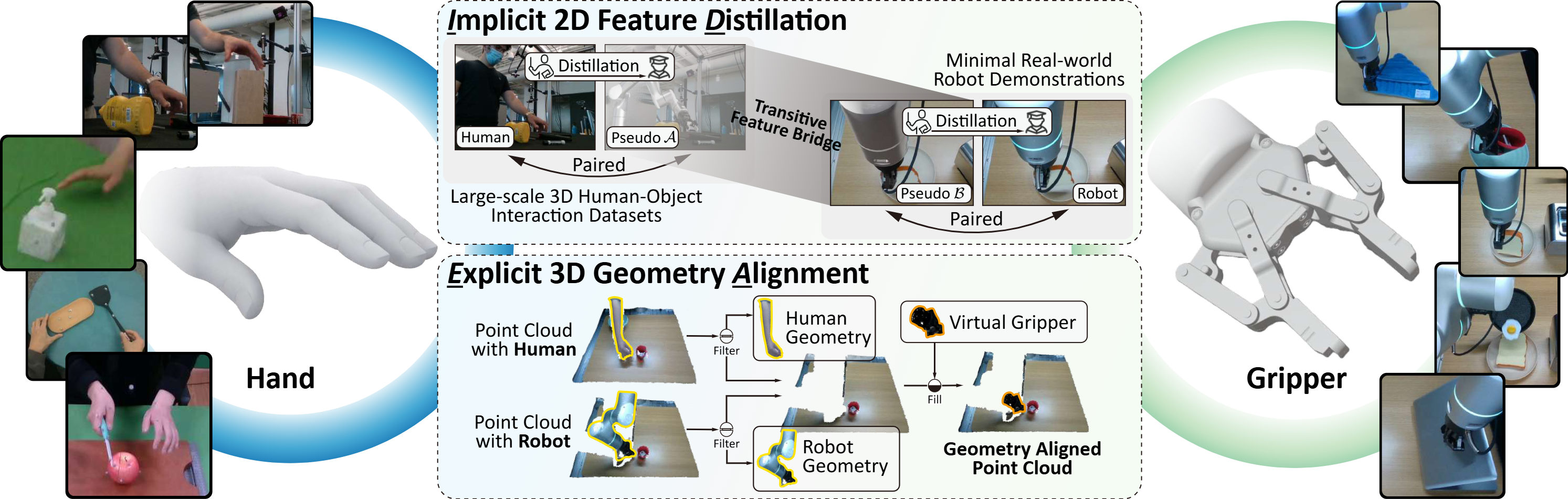
Scaling up robot learning is hindered by the scarcity of robotic demonstrations, whereas human videos offer a vast, untapped source of interaction data. However, bridging the embodiment gap between human hands and robot arms remains a critical challenge. Existing cross-embodiment transfer strategies typically rely on visual editing, but they often introduce visual artifacts due to intrinsic discrepancies in visual appearance and 3D geometry.
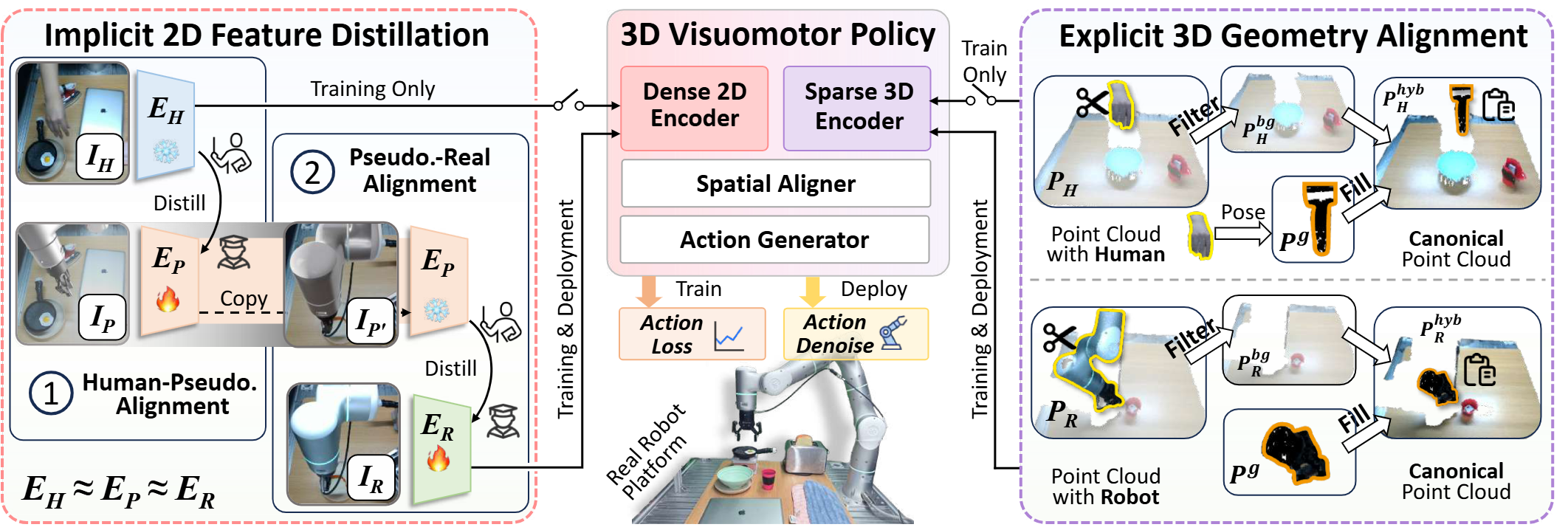
To address these limitations, we introduce LIDEA (Implicit Distillation and Explicit Geometric Alignment), a novel framework that enables direct policy learning from human videos. In the 2D visual domain, LIDEA employs a dual-stage transitive distillation pipeline that aligns human and robot representations in a shared latent space. In the 3D geometric domain, we propose an embodiment-agnostic alignment strategy that explicitly decouples embodiment from interaction geometry, ensuring consistent 3D-aware perception.
Extensive experiments empirically validate LIDEA through two complementary protocols evaluating data efficiency and cross-embodiment robustness. Results show that human data substitutes up to 80% of costly robot demonstrations, and the framework successfully transfers unseen patterns from human videos for out-of-distribution generalization. Our code and dataset will be made public.
The LIDEA Framework. (Left) Stage ① establishes semantic equivalence by distilling features from human observations to pseudo-robot counterparts. Stage ② then trains the real-robot encoder to match the pseudo-robot representations, achieving a shared latent space where EH ≈ EP ≈ ER. (Right) To construct a canonical 3D observation space, embodiment-specific geometries are filtered from the unprojected point clouds. A virtual gripper is then filled into the scene, yielding hybrid 3D observations. (Center) The 3D visuomotor policy fuses these aligned dense 2D features and sparse 3D tokens to predict continuous actions.
Why 3D scene flow? It provides dense geometric foresight for contact-rich manipulation. The Motion Expert uses a CogVideoX-style 3D Transformer to track K=400 keypoints across T=32 timesteps, trained via conditional flow matching with one-step partial denoising for efficient inference.
How to fuse motion without disrupting VLM semantics? A single-layer gated cross-attention with a learnable scalar gate initialized at zero (constrained to 0-1 by sigmoid) enables stable optimization—motion guidance gradually increases only when geometrically beneficial.
How to transfer to new robots? The Action Expert generates continuous action sequences from motion-guided VLM features. A two-stage training strategy enables embodiment-agnostic transfer—the motion prior transfers to unseen robots with only 10 warm-up demos.
LaMP achieves 98.3% SOTA on LIBERO benchmark, 96.7% on challenging long-horizon tasks, and 79.2% on SimplerEnv-WidowX (22.1% higher than second best). On LIBERO-Plus OOD perturbations, it outperforms the strongest baseline by +9.7%.
During inference, LaMP performs the following steps: (1) The Vision-Language Model encodes the observation and language instruction; (2) The Motion Expert generates one-step partially denoised 3D scene flow, extracting the hidden motion representation; (3) The Gated Motion Guidance module fuses the motion features with VLM features; (4) The Action Expert generates the final action sequence through flow matching. Crucially, full multi-step reconstruction is not required—only the hidden state provides geometric guidance.
Results on LIBERO and SimplerEnv-WidowX benchmarks. Best results in bold, second best underlined.
| Method | LIBERO | SimplerEnv-WidowX | ||||||||
|---|---|---|---|---|---|---|---|---|---|---|
| Spatial | Object | Goal | Long | Avg | Stack Block | Put Carrot | Put Spoon | Put Eggplant | Avg | |
| General VLA | ||||||||||
| OpenVLA | 84.7 | 88.4 | 79.2 | 53.7 | 76.5 | 0.0 | 0.0 | 4.2 | 12.5 | 4.2 |
| OpenVLA-OFT | 97.6 | 98.4 | 97.9 | 94.5 | 97.1 | – | – | – | – | – |
| π0 | 96.8 | 98.8 | 95.8 | 85.2 | 94.2 | 16.7 | 0.0 | 29.1 | 62.5 | 40.1 |
| π0.5 | 98.8 | 98.2 | 98.0 | 92.4 | 96.9 | 44.7 | 64.7 | 49.3 | 69.7 | 57.1 |
| GR00T N1 | 94.4 | 97.6 | 93.0 | 90.6 | 93.9 | 16.7 | 45.8 | 62.5 | 20.8 | 49.5 |
| Latent-Action VLA | ||||||||||
| UniVLA | 96.5 | 96.8 | 95.6 | 92.0 | 95.2 | 29.2 | 62.5 | 83.3 | 100.0 | 68.7 |
| villa-X | 97.5 | 97.0 | 91.5 | 74.5 | 90.1 | 61.3 | 46.3 | 77.9 | 64.6 | 62.5 |
| Video-Based VLA | ||||||||||
| mimic-video | 94.2 | 96.8 | 90.6 | – | 93.9 | 29.2 | 54.2 | 41.7 | 100.0 | 56.3 |
| WorldVLA | 87.6 | 96.2 | 83.4 | 60.0 | 81.8 | – | – | – | – | – |
| F1 | 98.2 | 97.8 | 95.4 | 91.3 | 95.7 | 50.0 | 70.8 | 50.0 | 66.7 | 72.9 |
| 2D Flow/Trace-Guided VLA | ||||||||||
| FlowVLA | 93.2 | 95.0 | 91.6 | 72.6 | 88.1 | 62.5 | 62.5 | 70.8 | 100.0 | 74.0 |
| TraceVLA | 84.6 | 85.2 | 75.1 | 54.1 | 75.8 | 16.6 | 16.6 | 12.5 | 65.0 | 27.7 |
| LaMP | 99.4 | 99.8 | 97.4 | 96.7 | 98.3 | 75.0 | 66.7 | 79.1 | 95.8 | 79.2 |
| w/o motion | 95.8 | 98.9 | 96.6 | 78.2 | 92.4 | 25.0 | 45.8 | 66.7 | 87.5 | 56.3 |
All models are trained on LIBERO and evaluated zero-shot on seven perturbation dimensions without additional training data.
| Method | Camera | Robot | Language | Light | Background | Noise | Layout | Avg |
|---|---|---|---|---|---|---|---|---|
| UniVLA | 1.8 | 46.2 | 69.6 | 69.0 | 81.0 | 21.2 | 31.9 | 42.9 |
| OpenVLA | 0.8 | 3.5 | 23.0 | 8.1 | 34.8 | 15.2 | 28.5 | 15.6 |
| OpenVLA-OFT | 56.4 | 31.9 | 79.5 | 88.7 | 93.3 | 75.8 | 74.2 | 69.6 |
| π0 | 13.8 | 6.0 | 58.8 | 85.0 | 81.4 | 79.0 | 68.9 | 53.6 |
| π0-Fast | 65.1 | 21.6 | 61.0 | 73.2 | 73.2 | 74.4 | 68.8 | 61.6 |
| WorldVLA | 0.1 | 27.9 | 41.6 | 43.7 | 17.1 | 10.9 | 38.0 | 25.0 |
| LaMP | 64.5 | 69.6 | 88.2 | 95.3 | 97.4 | 76.9 | 73.8 | 79.3 |
| w/o motion | 46.7 | 56.0 | 82.5 | 95.3 | 95.4 | 69.3 | 71.0 | 71.6 |
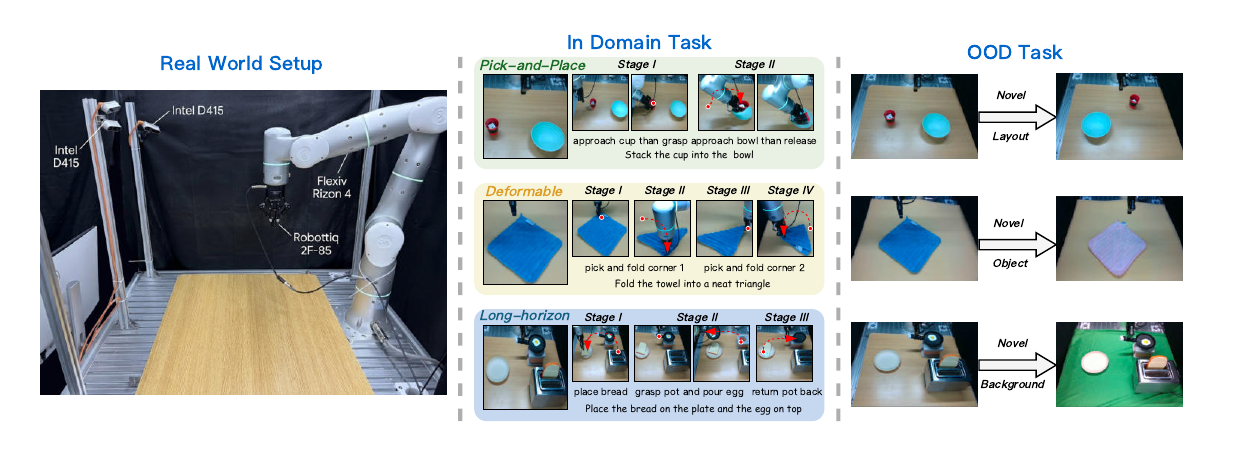
Real-world experimental platform. We use a Flexiv Rizon 4 robot arm with a Robotiq 2F-85 gripper and an Intel RealSense D415 camera for real-world evaluation.
LaMP outperforms π0 and 3D FDP across all tasks, with the largest gains on Deformable manipulation (50% vs 40% for both baselines) and OOD conditions (62.5% vs 26.8% for 3D FDP). Notably, 3D FDP collapses under distribution shift (−26.2 points), while LaMP degrades gracefully (−17.5 points), confirming that camera-frame geometric reasoning is more resilient to visual shifts than pixel-level representations.
If you find our work useful, please consider citing:
@inproceedings{wang2026lamp,
title={LaMP: Learning Vision-Language-Action Policy with 3D Scene Flow as Latent Motion Prior},
author={Wang, Xinkai and Wang, Chenyi and Xu, Yifu and Ye, Mingzhe and Zhang, Fucheng and Tian, Jialin and Zhan, Xinyu and Zhu, Lifeng and Lu, Cewu and Yang, Lixin},
journal={arXiv preprint},
year={2026}
}